
Why Your "Love Language" Might Be Lying to You—And What to Do Next
Conclusion: Beyond the Quiz—Meeting Luna

The 5 Love Languages are a powerful starting point for a conversation, but they are not the finish line. They give you a rough sketch of the terrain, but they don't teach you how to navigate the weather.
In 2025, lasting connection requires a blend of intentionality, Micro-mance, and scientific awareness. If you’re ready to move beyond the simple 1992 categories and gain a more nuanced, clinically-informed understanding of your relationship, it’s time to meet Luna.
Luna is a professional AI relationship diagnostic tool designed to bridge the gap between classic theory and modern relationship science. By interacting with Luna, you can move past the surface-level quiz results and receive private, expert-informed insights tailored to your specific life stage and relationship structure.
Don't just take a quiz—build a strategy. Take the next step with Luna and discover what your love language truly means for your relationship today.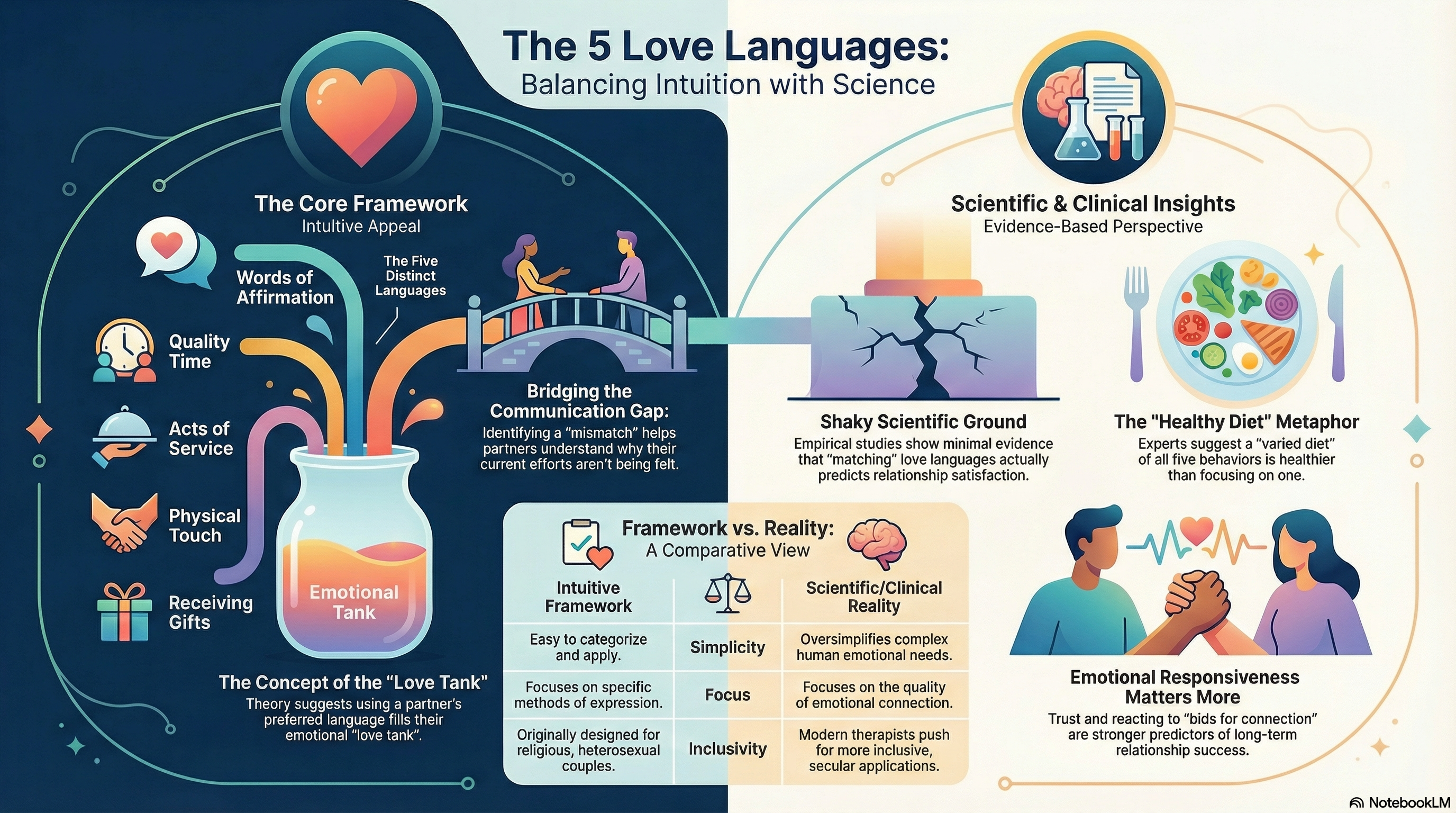
You’re refreshing the results page on that "Love Languages Test" for the third time this year, hoping for a breakthrough. You’ve memorized your partner’s primary category, you’ve optimized your behavior to match it, and you’ve logged more "Acts of Service" than a full-time concierge. Yet, that nagging sense of emotional malnutrition persists. You’re doing everything the 1992 playbook suggests, but the needle isn't moving.
This is the central paradox of modern romance: the more we lean on Gary Chapman’s thirty-year-old framework, the more we realize it was never meant to be a magic cure. Originally published by Chapman—a Baptist minister whose PhD is in Adult Education, not clinical psychology or marriage therapy—The 5 Love Languages was born from anecdotal session notes rather than empirical data. While it provided a revolutionary "shared vocabulary" for millions, the digital complexity of 2025 demands a more sophisticated, research-backed "Love Map."
1. The "Superfood" Myth vs. The "Varied Diet"
One of the most pervasive pitfalls in relationship strategy is the belief that a single "primary" love language can sustain a partnership. We treat it like a superfood—if we just get enough of that one nutrient, the relationship stays healthy. Modern clinical science suggests the opposite.
"Healthy love might be better understood as a varied diet of different loving behaviors. In this sense, the five love languages are more like fruits, vegetables, and dairy than they are a superfood that meets all your nutritional needs." — Charlie Huntington, Psychology Today
When we over-index on one language, we risk creating a deficit in the relationship’s "emotional bank account." If you focus exclusively on "Quality Time" while neglecting "Words of Affirmation," you are essentially offering a partner a diet high in protein but devoid of essential vitamins. Long-term relational maintenance requires a broad spectrum of loving behaviors to prevent emotional starvation.
2. 2025: The Rise of "Micro-mance" as Relational Vitamins
If love is a diet, then 2025 is the year of the relational vitamin. According to Bumble’s 2025 dating trends, 86% of singles surveyed agree that the way we show affection has shifted away from grand, sweeping gestures toward "Micro-mance." These are small, consistent digital and social behaviors that act as the daily nutrients of a modern connection.
Modern Micro-mance gestures include:
· Digital Bids: Sending a niche meme that references an inside joke.
· Curated Connection: Sharing a personalized playlist or an article that says, "I saw this and thought of you."
· Inside Logic: Leaning into "geeking out" over shared quirky interests (like thrifting or trivia) as a form of intimacy.
· Micro-moments: A 10-second "thinking of you" text that provides emotional stability during a high-stress workday.
Strategist’s Note: Don’t just "like" the meme your partner sends; see it as a "digital bid" for connection and respond with a comment to acknowledge their effort.
3. The Scientific "Shaky Ground"
To navigate modern intimacy, we must apply the skepticism of a researcher to the framework we use. Chapman’s categories were a brilliant starting point, but they are not clinical law.
Common Belief | Research Reality |
Matching love languages makes you happier. | Satisfaction depends on effort and "self-regulation" (Impett et al., 2024), not on having identical profiles. |
There are exactly five distinct languages. | Categories frequently overlap (Egbert & Polk, 2006); for instance, Quality Time and Words of Affirmation are rarely distinct in practice. |
The theory is scientifically proven. | The framework is based on anecdotal notes from Adult Education, not empirical, peer-reviewed psychological data. |
4. Misconceptions That Kill Connection
Misreading a partner's emotional dialect doesn't just miss the mark—it creates a deficit. We must move beyond surface-level definitions to understand the underlying psychology.
Receiving Gifts: Symbolism Over Materialism
This language is frequently maligned as shallow, but it is actually an exercise in semiotics. A gift is a tangible symbol that says, "You were in my thoughts while we were apart." It is about thoughtfulness and emotional intention, not the price tag. The "hurt" in this language occurs when a partner forgets a significant occasion, which registers as being forgotten as a person.
Physical Touch: Oxytocin Over Intimacy
Physical touch is about routine affection—hugs, hand-holding, and non-sexual proximity. These gestures stimulate the release of oxytocin, the "bonding hormone," which builds the foundation of safety.
· The Critical Boundary: A dangerous misapplication of this theory involves using "Physical Touch" as leverage to pressure a partner for sexual intimacy. Healthy intimacy requires consent and mutual desire. Experts from Simply Psychology warn that Chapman’s original text even included a chilling anecdote where he advised a woman to meet the "language" of an abusive husband through sexual intimacy. In 2025, we must be clear: a love language is never a mandate for sex, and it should never supersede personal boundaries or safety.
5. Bids for Connection: The Building Blocks of the "Love Map"
To supplement the love languages, we must integrate the research of Dr. John Gottman. He identifies "Bids for Connection"—small moments where one partner reaches out for attention or affirmation.
Gottman’s research shows that the most reliable predictor of relationship success is not "matching" languages, but "turning toward" these bids. This consistent responsiveness builds a "Love Map"—a deep, updated understanding of your partner’s inner world.
· The 5:1 Ratio: Stable relationships maintain five positive interactions for every one negative interaction.
· The Emotional Bank Account: Every time you turn toward a bid (even a small one), you make a deposit. During conflict, these deposits are what keep the relationship from bankruptcy.
6. Closing the "Inclusivity Gap"
We must acknowledge that the 1992 framework was written through a specific lens: a heteronormative, religious, and traditional one. Modern users should think critically about these origins:
· Heteronormativity: The original quizzes often rely on dated "husband/wife" stereotypes that don't always translate to LGBTQ+ or non-monogamous dynamics.
· The Safety Risk: The emphasis on unconditional "service" in the original work has been critiqued for encouraging partners to endure toxic or abusive dynamics for the sake of the marriage.
To be a "Digital Content Architect" of your own relationship, you must adapt this framework to fit your specific values, ensuring that "speaking a language" never comes at the cost of your self-respect or safety.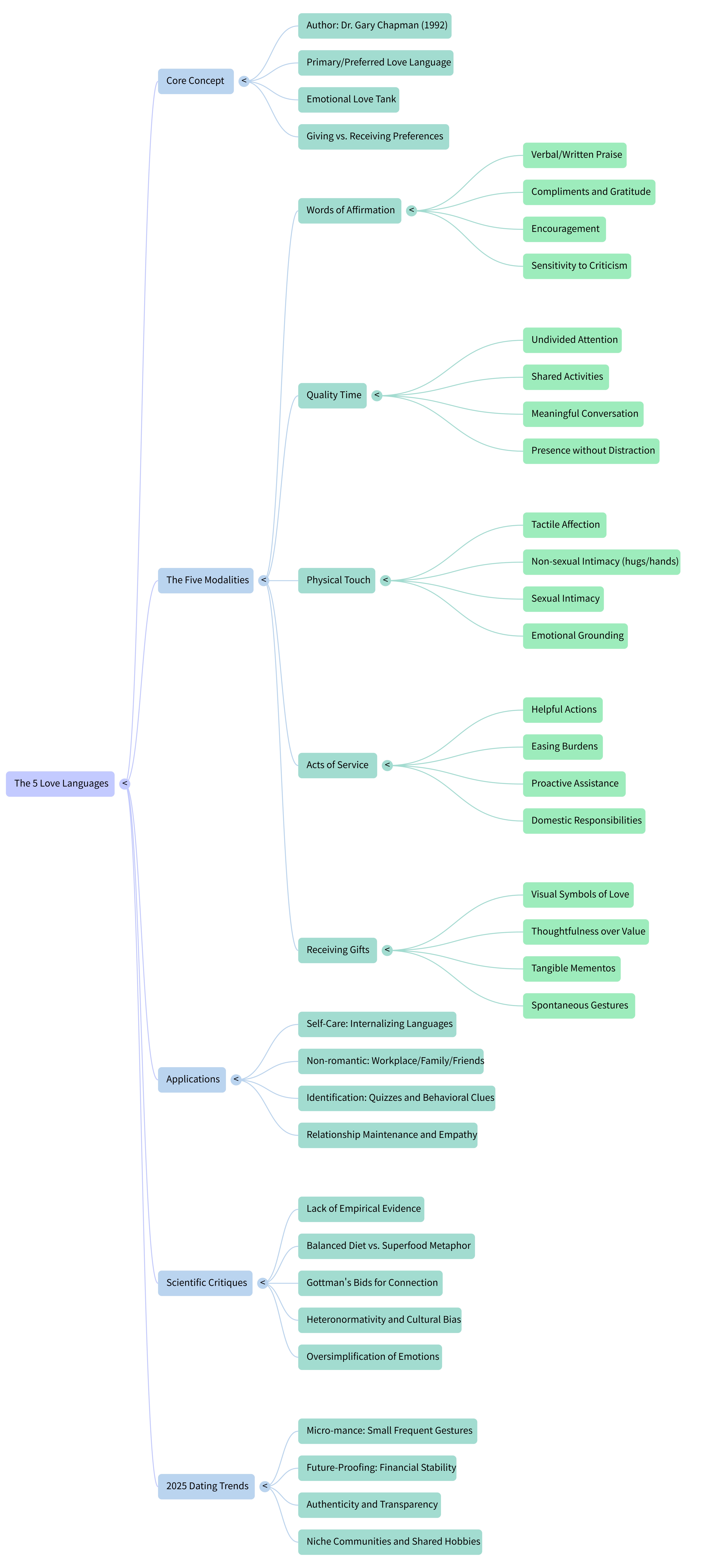

Comments (0)