
Beyond the Tank: Why the 5 Love Languages are Evolving into the Love Diet of 2025
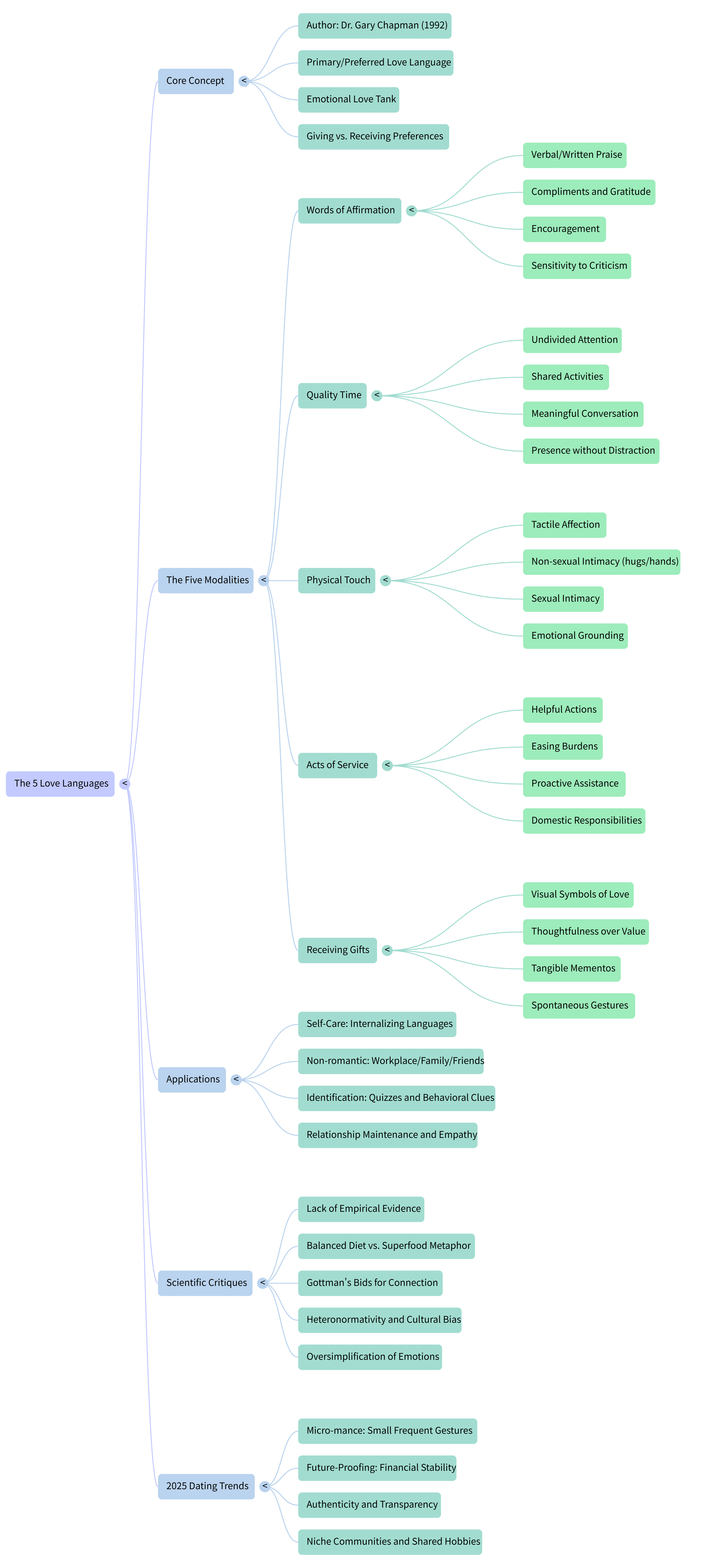
(A summary mind map is included at the end of the article; please feel free to download it.)
Since 1992, Gary Chapman’s "Emotional Love Tank" has served as the primary metaphor for modern romance. Derived from twelve years of personal session notes during his time as a counselor, Chapman’s framework offered a simple, intuitive solution to the problem of couples "speaking past each other." Yet, despite the theory’s cultural ubiquity, many contemporary couples find themselves in a frustrating stalemate. In 2025, the conversation is shifting from static categories toward a more sophisticated, evidence-based understanding of relational maintenance.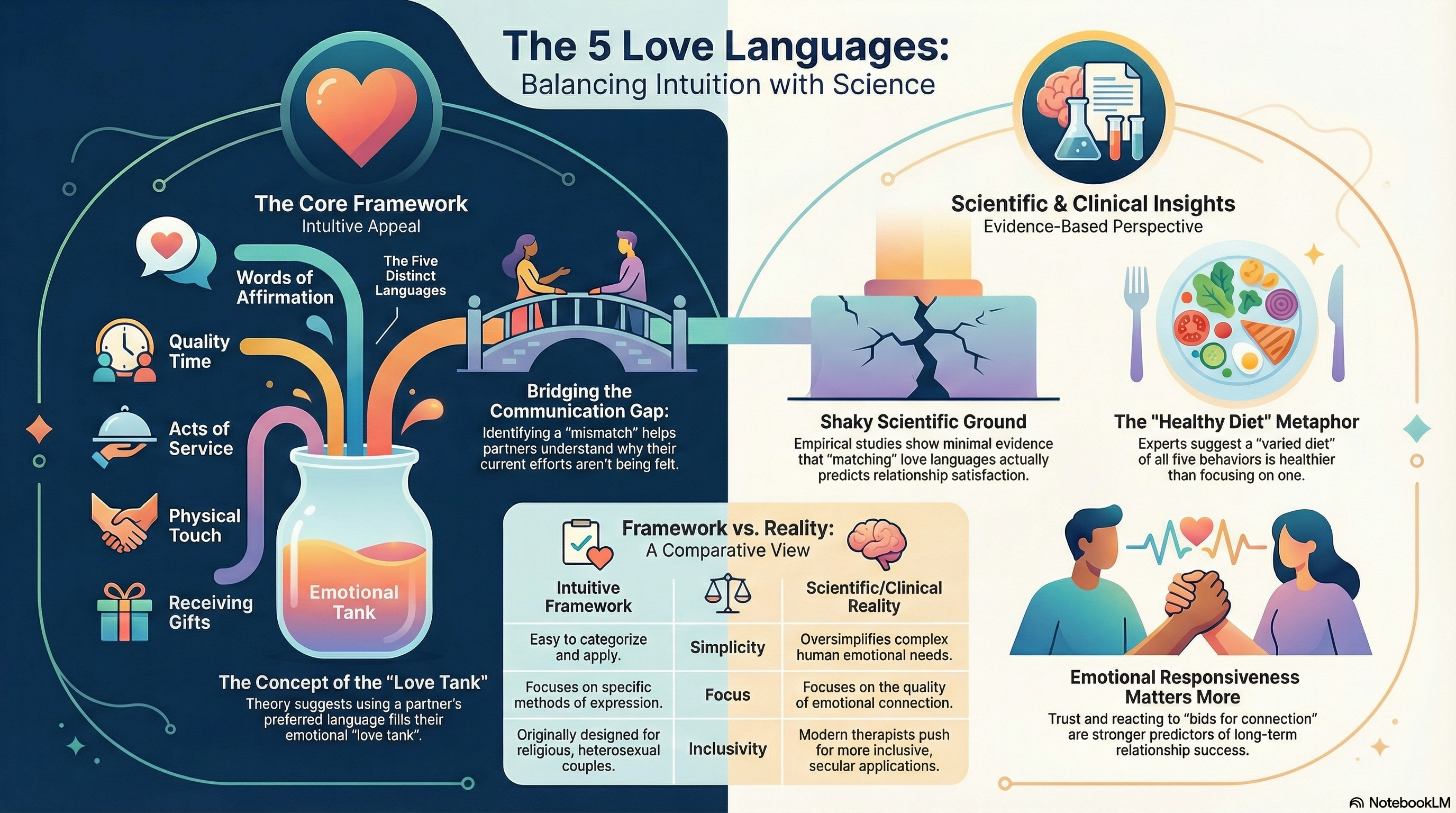
1. The "Superfood" Myth vs. The Varied Relationship Diet
Recent psychological research is dismantling the "primary love language" myth. A landmark review by Impett et al. (2024) suggests that the "superfood" model—the idea that one specific behavior can satisfy all emotional requirements—is fundamentally flawed. Instead, relationship health is better predicted by a "varied diet" of behaviors.
- The "Superfood" Approach: Operates on the assumption that identifying a single primary language (e.g., Acts of Service) is the silver bullet for relationship satisfaction, often leading to the undervaluation of other essential loving behaviors.
- The "Varied Diet" Approach: Posits that while preferences exist, a healthy relationship requires a diverse range of expressions to meet a partner's evolving emotional and psychological needs.
"The love you receive is like your diet, and you are healthiest when your diet is rich and varied. In this sense, the five love languages are more like fruits, vegetables, and dairy than they are a superfood that meets all your nutritional needs."
2. The Heavy Hitters: Words and Time
While Chapman’s original theory grants all five languages equal weight, empirical validation suggests otherwise. A 2025 study by Flicker and Sancier-Barbosa found that "Words of Affirmation" and "Quality Time" are the strongest predictors of long-term satisfaction, regardless of an individual’s self-identified preference.
From a neurobiological perspective, these "sustained and interactive" behaviors are powerhouse triggers for oxytocin—the "bonding hormone" essential for deep emotional security. Before you can bridge the gap with a partner, however, you must achieve internal alignment. Tools like Clarity serve as a companion for self-discovery, helping you distill your own complex needs into a clear personal roadmap before you attempt to communicate them. You can begin that process of internal mapping at anruby.com.
3. "Micro-mance" as the 2025 Love Language
The evolution of intimacy is moving away from grand gestures toward what 2025 dating data from Bumble calls "Micro-mance." This trend reflects a shift toward digital intimacy and the "dialects" Chapman once hinted at—specific, nuanced ways of expressing affection within a digital context.
For Gen Z and younger Millennials, "geeking out together" over niche interests has become a vital form of intimacy. Modern Micro-mance includes:
- Sharing curated digital playlists that reflect a shared history.
- The "meme-as-metaphor": sending specific images that reinforce inside jokes.
- The "digital check-in": a quick photo of something seen during a walk to signal presence.
When these small, meaningful feelings are difficult to articulate, Iris, the relationship letter writer, helps translate the subtlety of Micro-mance into written expressions that resonate. Discover how to find your voice at anruby.com.
--------------------------------------------------------------------------------
4. Effort Trumps "Matching"
The traditional advice—find a partner who speaks your "native" language—is being replaced by the concept of the Bilingual Partner. Research by Bunt & Hazelwood (2017) indicates that the "matching" of languages is far less important than the mutual effort to adapt.
Key Insight: The Power of Self-Regulation Success in 2025 depends on self-regulation: the cognitive ability to adjust one's natural behavioral style to meet a partner’s specific needs. Notably, studies show that a female partner's self-regulation is a particularly high predictor of satisfaction for both parties. Navigating this shift from "knowing" a theory to "practicing" the work can be daunting. Alex acts as the warm, knowledgeable friend to talk to when facing relationship confusion, helping you navigate the technical demands of emotional labor. Connect with Alex at anruby.com.
--------------------------------------------------------------------------------
5. The "Fine Print" of the Framework
As relationship journalism becomes more rigorous, the critical limitations of the 1992 framework have come into sharper focus. Sophisticated readers must account for three specific areas:
- Scientific Validity: The theory lacks empirical, peer-reviewed origins, relying instead on Chapman’s anecdotal observations within a pastoral, non-clinical setting.
- Inherent Bias: The framework’s roots are heavily heteronormative and religious, which can alienate secular or LGBTQ+ couples who find the traditional "husband and wife" roles restrictive.
- The Safety Gap: There is a documented risk of using the "Physical Touch" language to bypass consent or minimize the impact of toxic dynamics.
Experts point to a specific, historical danger in the framework’s application within power-imbalanced or abusive relationships.
"Chapman advised a woman in an emotionally abusive marriage to meet her husband’s 'love language' (physical touch) through sexual intimacy, despite her distress. Experts criticize this type of advice for prioritizing marriage preservation over individual well-being, potentially endangering victims by encouraging self-sacrifice to appease abusive partners."
Conclusion: Moving Toward "Love Maps"
The path forward in 2025 is to move beyond the five "tidy boxes" and toward the more dynamic concept of Love Maps, popularized by the Gottman Institute. A Love Map is not a static category but a deep, ever-evolving understanding of your partner’s internal world—their fears, shifting goals, and niche joys.
While the love languages provide a useful vocabulary, they are merely the beginning of the conversation. True connection requires us to be cartographers of our partners’ souls, constantly updating the coordinates as they grow.
Is your "love tank" empty because you're speaking the wrong language, or because you've stopped updating the map of your partner's inner world?
--------------------------------------------------------------------------------

Comments (0)